
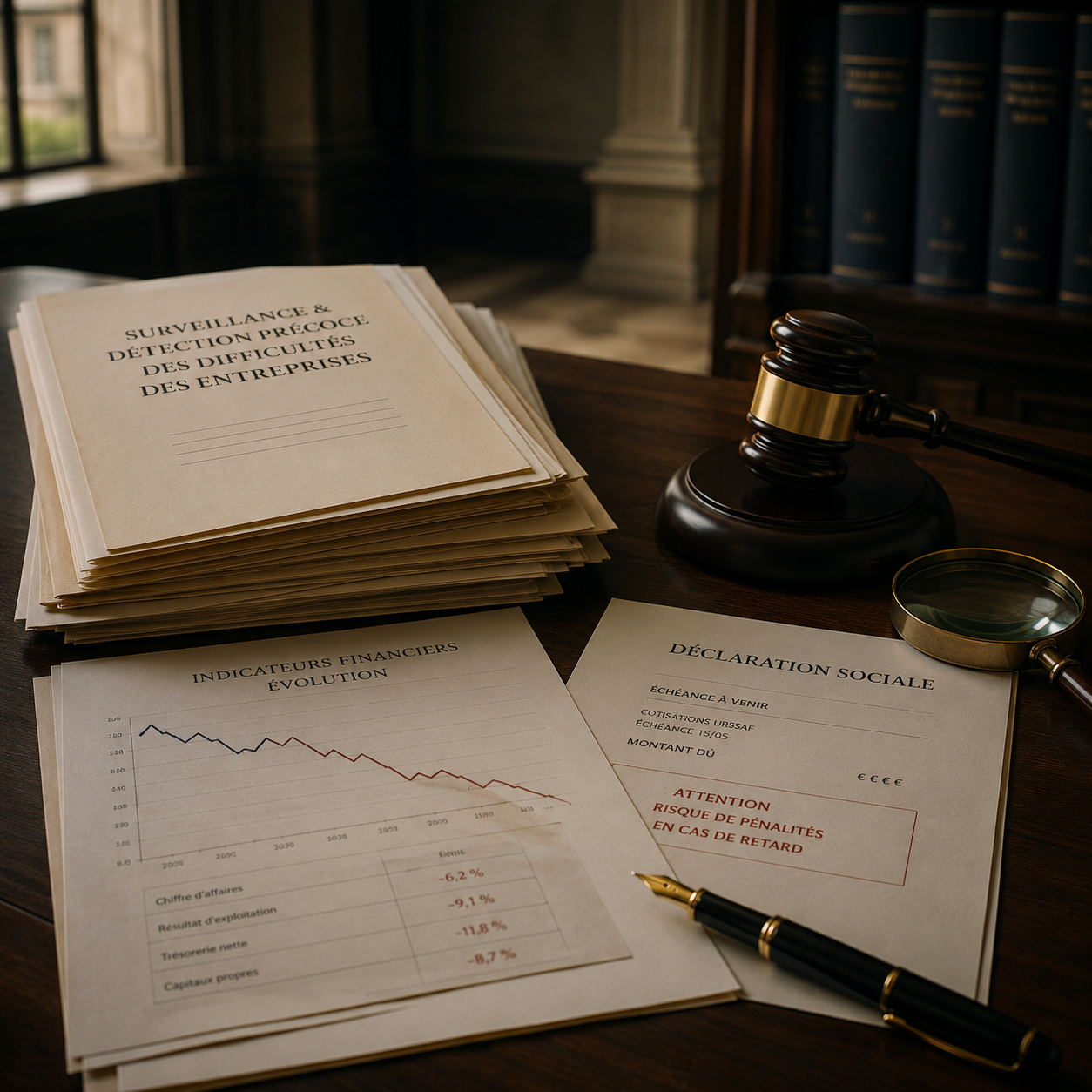

Business Failures: Social Security Debt Becomes a Judicial Warning Signal
Business failures have returned to a historically high level. After several years marked by public aid, State-guaranteed loans, deferred charges and exceptional measures linked to the health crisis, many companies now face a more constrained environment: rising costs, debt repayment, cash-flow strain, slowdowns in certain markets and tighter financing conditions.
In this context, the law on companies in difficulty is gradually moving towards earlier detection. The aim is no longer only to deal with the crisis once it has set in, but to identify weak signals before the company slides into collective insolvency proceedings (procédure collective).
The entry into force, on 1 July 2026, of the new Article L. 115-10 of the French Social Security Code forms part of this movement. This provision allows the collection bodies, in particular the URSSAF (French social security contributions collection body), the general social security funds and the MSA (agricultural social security body), to pass to the president of the competent court certain information on companies' social security debts, where these exceed a threshold set by decree.
This reform marks an important development: social security debt is no longer merely a matter of recovery between the company and the social security body. It also becomes a signal capable of feeding the judicial prevention of difficulties.
Why do business failures remain at a high level?
The rise in failures cannot be explained by a single factor. It results from a combination of several economic phenomena.
First, the Covid period postponed a number of difficulties without always resolving them. Public aid, short-time working, deferred charges and State-guaranteed loans made it possible to avoid an immediate wave of failures. But some companies emerged from this period with more debt, weakened cash positions and reduced margins.
Second, rising costs have deeply affected the most fragile business models. Increases in the price of energy, raw materials, rents and salaries, and in the cost of credit, have squeezed margins. For SMEs and very small enterprises, which often have limited equity, this pressure can quickly turn into a cash-flow difficulty.
Finally, the slowdown in certain sectors, in particular construction, retail, transport, catering and certain business services, has aggravated the strain. A company may remain commercially viable but find itself in difficulty because it can no longer absorb the gap between its receipts and its payments.
Failure is thus often caused less by a lack of activity than by insufficient cash. This is why managing cash, tax and social security debts, bank repayment dates and payment terms becomes a central issue for managers and finance departments.
What Article L. 115-10 of the French Social Security Code changes
Article L. 115-10 of the French Social Security Code, created by the Social Security Financing Act for 2026, provides that certain collection bodies must communicate to the president of the competent commercial court (tribunal de commerce) or judicial court (tribunal judiciaire) the amount of the debts owed by a contributor where that amount exceeds a threshold set by decree.
The text states that this communication may take place without professional secrecy being an obstacle. It leaves it to a decree, however, to set the implementing rules, in particular how often the communication is made and the amount of the threshold that triggers transmission.
The mechanism should not be misunderstood. It is not an automatic sanction. It does not mean that a company with an URSSAF debt will automatically be placed in judicial reorganisation (redressement judiciaire) or judicial liquidation (liquidation judiciaire). The text provides for information to be passed to the court president, who may then assess the situation within the scope of his or her prevention powers.
In other words, social security debt becomes an institutional indicator of difficulty. Once it exceeds a certain level, it may draw the court president's attention before the company's situation deteriorates further.
The role of the court president in preventing difficulties
The court president already has prevention powers. Article L. 611-2 of the French Commercial Code allows the president, on becoming aware of difficulties likely to jeopardise the continuity of a company's business, to summon its managers in order to consider measures capable of restoring the situation.
This summons is not a collective insolvency proceeding. It does not remove the manager from office and does not make the company's situation public. It allows the court president to speak with the manager, understand the origin of the difficulties and, where appropriate, steer the manager towards prevention tools.
With Article L. 115-10 of the French Social Security Code, the information passed on by the social security bodies may become one of the signals triggering this prevention approach. A significant social security debt may reveal cash-flow strain, a lack of financial control, a profitability problem or a cyclical difficulty requiring rapid action.
The court president therefore does not receive the information in order to penalise the company, but to assess whether preventive action should be considered.
A move towards early detection of weak signals
French law on companies in difficulty increasingly rests on a simple idea: the earlier the company acts, the more solutions are available.
For a long time, difficulties were mainly dealt with at the stage of collective insolvency proceedings, when cash-flow insolvency (cessation des paiements) was already established. Today, prevention tools occupy a growing place. The ad hoc mandate (mandat ad hoc) and conciliation make it possible to negotiate with the main creditors in a confidential setting, before the company is placed in judicial reorganisation or judicial liquidation.
The ad hoc mandate, provided for in Article L. 611-3 of the French Commercial Code, is a particularly flexible tool. It allows the manager to ask the court president to appoint a mandatary to help negotiate with certain partners: banks, landlords, strategic suppliers, investors, tax and social security bodies.
Conciliation, provided for in Articles L. 611-4 et seq. of the French Commercial Code, is a more structured mechanism. It may be opened where a company experiences a legal, economic or financial difficulty, actual or foreseeable, provided it has not been in cash-flow insolvency for more than forty-five days. It makes it possible to seek an amicable agreement with the main creditors.
These procedures have a major advantage: their confidentiality. Article L. 611-15 of the French Commercial Code imposes a duty of confidentiality on any person called to a conciliation or ad hoc mandate procedure, or who becomes aware of it through their functions.
The point is therefore to intervene early enough, before the strain becomes irreversible.
Practical consequences for managers and finance departments
For managers and chief financial officers (DAF), this development requires a change of method.
The first consequence concerns the monitoring of social security debts. URSSAF or MSA arrears can no longer be regarded as a mere administrative or one-off matter. When they build up, they may become a signal of difficulty passed to the court president. It is therefore essential to anticipate, to request payment schedules where necessary, and to document the company's situation.
The second consequence concerns cash management. In a context of economic strain, a forecast profit and loss account is not enough. The company must have a precise cash-flow forecast, regularly updated, making it possible to identify critical due dates at four, eight or twelve weeks.
The third consequence concerns dialogue with financial and institutional partners. A bank, a strategic supplier or a social security body will be more inclined to support a company that presents a clear, documented and anticipated situation. Conversely, the silent accumulation of debts reduces trust and gradually closes off options.
Finally, managers must accept that using prevention tools is not an admission of failure. The ad hoc mandate and conciliation are not bankruptcy procedures. They are negotiation and restructuring tools, intended to prevent a temporary difficulty from turning into collective insolvency proceedings.
Good practice for anticipating difficulties
The first good practice is to put in place simple warning indicators that are monitored regularly: available cash, customer arrears, supplier debts, tax and social security debts, margin decline, level of indebtedness, bank repayment dates and compliance with financial covenants.
The second is to prepare a realistic cash-flow forecast. This document must include several scenarios: a central scenario, a downside scenario and a crisis scenario. It should not serve to give artificial reassurance, but to identify the point at which a decision will have to be taken.
The third is to open dialogue early enough with key creditors. A request for a payment schedule or restructuring is more likely to succeed when it is presented before payment incidents accumulate, with precise figures and a credible plan.
The fourth is not to remain alone. When a difficulty arises, the manager must be able to rely on advisers, the chartered accountant (expert-comptable), the lawyer, financial partners and, if necessary, the judicial prevention mechanisms.
The fifth is to use the amicable procedures at the right time. The ad hoc mandate and conciliation are all the more effective when requested before cash-flow insolvency or at the very start of the cash crisis.
Frequently asked questions
Does an URSSAF debt automatically lead to collective insolvency proceedings?
No. Article L. 115-10 of the French Social Security Code does not provide for the automatic opening of collective insolvency proceedings. It provides for information to be passed to the court president when the conditions set by the text and the implementing decree are met.
Can the court president summon the manager?
Yes. If the information received reveals difficulties likely to jeopardise the continuity of the business, the court president may summon the manager under his or her prevention powers, in particular on the basis of Article L. 611-2 of the French Commercial Code.
Are the ad hoc mandate and conciliation public?
No. These procedures are confidential. This confidentiality is essential because it allows the company to negotiate with its partners without provoking an immediate loss of confidence among customers, suppliers or funders.
What is the difference between an ad hoc mandate and conciliation?
The ad hoc mandate is the most flexible tool. Its mission is set by the court president according to the company's needs. Conciliation is more tightly framed and aims at concluding an amicable agreement with the main creditors within a set period.
When should action be taken?
As early as possible. A financial difficulty is not necessarily a failure. However, a difficulty that is ignored or dealt with too late greatly reduces the options available. The more the company anticipates, the more negotiating leverage it keeps.
Conclusion
The entry into force of Article L. 115-10 of the French Social Security Code illustrates a profound change in the treatment of company difficulties. The approach is no longer only curative. It is becoming increasingly preventive.
Social security debt becomes a warning signal that may be passed to the court president. This signal does not automatically lead to collective insolvency proceedings, but it may lead to earlier intervention by the prevention mechanisms.
For managers and finance departments, the message is clear: cash-flow strain, social security arrears and payment difficulties must be dealt with early enough. Prevention is not the antechamber of bankruptcy. It is often the best way of avoiding it.
Faced with a financial difficulty, suitable legal support makes it possible to identify the tools available, secure exchanges with creditors and preserve the company's prospects of recovery.
To take this analysis further, a talk devoted to these issues is available here:
Quatre questions suffisent à situer votre position, le délai qui vous reste et ce qu'il faut vérifier en priorité. Vous décidez ensuite si vous en parlez au cabinet.
Décrire ma situationA business whose cash flow is tightening?
Once forty-five days have passed since the cessation of payments, options narrow and the director's liability is exposed.


