
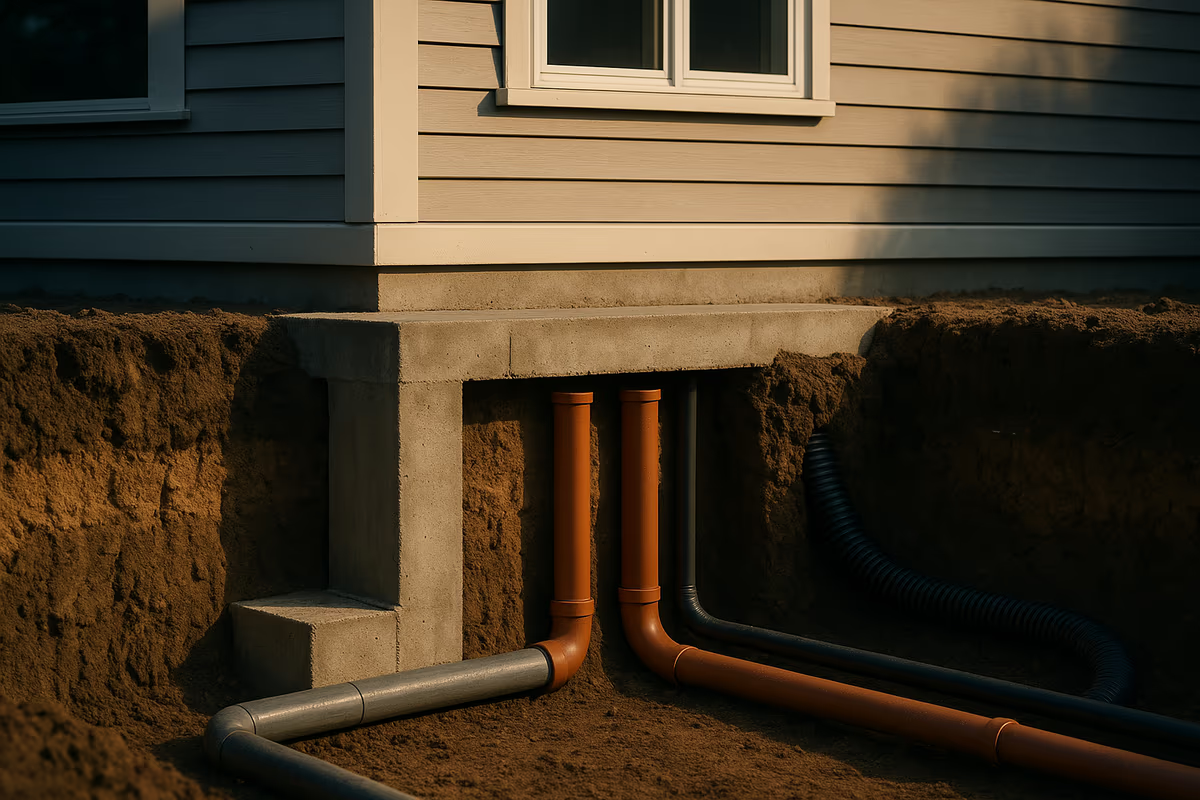

An owner decides to extend his house, dig a swimming pool or add a basement level. On rereading his title deed, he discovers that a sewer pipe runs through the subsoil of his land for the benefit of the neighbouring property: an underground easement (servitude de tréfonds). Is the project doomed? Not necessarily. The right to build over an underground easement is neither entirely free nor entirely prohibited. It depends on the exact route of the burden (assiette), the actual interference caused by the construction, and the relocation or compensation solutions provided by the French Civil Code. This article sets out the rights of the owner of the servient land (fonds servant) who wishes to build, the applicable case law, and the ways of unblocking a property project held up by an underground easement.
What an underground easement is and why it limits the right to build
The tréfonds is the underground part of a piece of land. Article 552 of the French Civil Code provides that "ownership of the soil carries with it ownership of what is above and below it". In other words, the owner of land is in principle master of his subsoil as well as its surface, and may dig, lay foundations and build in it. The underground easement tempers this principle: it burdens the subsoil of one piece of land, the servient land, for the benefit of a neighbouring piece of land, the dominant land (fonds dominant). The cases in which the owner may object to such a burden, and the procedure to follow, are examined in our article on refusing an underground easement.
Article 637 of the French Civil Code defines an easement as "a burden imposed on an estate for the use and benefit of an estate belonging to another owner". Underground easements arise in very practical situations:
- a drinking water, sewage or rainwater drainage pipe running under the neighbouring land
- electric cables, optical fibre or a gas pipe
- a gallery, vaulted cellar or tunnel belonging to the dominant land
- structures forming part of a public network (mains drainage, telecommunications)
For someone who wishes to build, the difficulty lies in the very nature of this type of easement. A surface right of way can be seen and worked around. An underground easement is invisible, often forgotten, and it occupies precisely the volume in which foundations, piles, a buried basement or a pit are anchored. It is this overlap between the route of the easement and the footprint of the project that creates the conflict. How a pipeline easement arises and how the owner of the land crossed is compensated are detailed in our article on the easement for underground pipes.
Distinguishing the route of the easement from the rest of the subsoil
An underground easement does not immobilise the whole of the subsoil of the land. It applies to a route (assiette), that is to say a defined strip of land, at a given depth, determined by the instrument creating it or by usage. The owner of the servient land retains full ownership and use of the rest of the subsoil. The first question to resolve is therefore not "can I build?" but "where exactly does the easement run, and does my project encroach on its route?".
This distinction governs the whole analysis. An extension built away from the pipe, with foundations that do not go down to its depth, raises no legal difficulty. The conflict arises only when the construction crosses or overhangs the route in a way that hinders the exercise of the easement.
The principle: building remains possible, aggravating the easement is prohibited
The rights of the owner of the servient land are governed by Article 701 of the French Civil Code, which is the central text on this subject. Its first paragraph states:
"The owner of the land burdened by the easement may do nothing which tends to diminish its use or to make it more inconvenient. Thus, he may not change the state of the premises, nor transfer the exercise of the easement to a place different from that to which it was originally assigned."
This text does not prohibit building. It prohibits interfering with the easement. The nuance is decisive. The owner of the servient land remains the holder of his right of ownership, protected by Article 544 of the French Civil Code, which defines ownership as "the right to enjoy and dispose of things in the most absolute manner". He may therefore build on his land, including above an underground easement, provided that the construction does not diminish the use of the easement or make it more inconvenient.
In practice, this opens up several scenarios. An owner who wishes to build a terrace or a light conservatory above a deep pipe, without touching it or obstructing the access needed for its maintenance, is acting within his rights. Conversely, a buried basement that encases a sewer pipe, prevents it from being cleaned or makes any replacement impossible amounts to a prohibited aggravation. The court always reasons in concreto: it looks at the actual interference, not the theoretical interference.
Interferences that actually block the works
Three types of interference recur systematically in disputes over building on an underground easement:
- Physical damage to the structure: foundations, piles or a slab that crush, crack or displace the pipe. This is the most obvious interference and the hardest to defend.
- Obstruction of access and maintenance: an underground easement is almost always accompanied by an ancillary right of access to the structure in order to repair it. A construction that makes it impossible to open a trench, clean or replace a pipe makes its use "more inconvenient" within the meaning of Article 701.
- Overloading the route: a heavy building above a gallery or vaulted cellar may compromise the stability of the dominant structure. The interference is not immediate but it is real.
The case law of the civil courts has long accepted that the owner of the dominant land may put an end to a construction that compromises the exercise of his easement, including by obtaining its demolition. This is the major risk for someone who builds without checking the route: starting works, then being ordered to demolish an extension because it buries a pipe that is vital to the neighbour.
Relocating the easement: the solution provided by Article 701
The French Civil Code does not leave the owner of the servient land a prisoner of a pipe laid decades ago. Article 701, in its second part, provides a safety valve: the relocation of the easement. The text continues:
"However, if this original assignment had become more burdensome to the owner of the servient land, or if it prevented him from making advantageous repairs, he could offer the owner of the other land an equally convenient place for the exercise of his rights, and the latter could not refuse it."
This mechanism is the key to reconciling an underground easement with construction. It allows the owner of the servient land to propose a new location for the easement in order to free up the route where he wishes to build. Three cumulative conditions structure this right.
First condition: a characterised inconvenience
Relocation requires that the original location has "become more burdensome" or that it prevents "advantageous repairs". The notion of repair has been interpreted broadly by the courts. They accept that preventing a construction, development or enhancement project on the servient land falls within the scope of the text. An owner who wishes to build an extension, dig a basement or densify his plot may therefore rely on Article 701, provided that he shows that the easement stands in the way of a serious and useful project.
The condition is not purely formal. It is not enough to invoke a vague wish to extend. The owner must establish the reality and usefulness of his project, generally by a building permit, plans or a substantiated architectural project.
Second condition: offering an equally convenient location
Relocation is not a disguised removal. The owner of the servient land must offer the dominant land an "equally convenient" location for the exercise of the easement. The pipe must continue to perform its function with equivalent efficiency. A new route that would excessively lengthen the course, reduce the flow, multiply the bends or complicate maintenance would not be "equally convenient" and could be refused by the court.
This is where technical expertise becomes decisive. The owner should have the new route designed and costed by an engineering consultancy before opening discussions, in order to demonstrate functional equivalence.
Third condition: bearing the cost of relocation
Relocation is carried out at the expense of the person requesting it, that is to say the owner of the servient land who wishes to build. He finances the works to divert the pipe, the reinstatement of the route and the making good. This financial burden is the counterpart of the freedom regained over the original route. The dominant land must suffer neither cost nor loss of convenience.
When these three conditions are met, the text is mandatory: the owner of the dominant land "could not refuse it". A systematic and abusive refusal exposes him to the relocation being ordered by the court. The legal balance of power is reversed: it is no longer the owner of the servient land who suffers the easement, but the dominant land that must accept a reasonable relocation that is fully financed.
Check the instrument creating the easement first: the step wrongly skipped
Before relying on Article 701 or drawing up a project, the instrument creating the easement must be examined. An underground easement most often arises from a notarial deed, an agreement between neighbours or a division of property. That instrument defines the route, the depth, the arrangements for access and sometimes the conditions for relocation.
Several checks determine the strategy:
- The exact route: its width, its course, its depth. A project can sometimes fit alongside the route without ever requiring relocation.
- Relocation clauses: some agreements themselves set out the conditions for diversion, more flexible or stricter than Article 701. By virtue of the freedom of contract recognised for contractual easements, these clauses prevail.
- Public easements: where a public network runs through the subsoil (mains drainage, telecommunications, electricity distribution), the regime is governed by specific texts and requires the agreement of the network operator. The private law of Article 701 is no longer sufficient, and the authorisation of the concession holder or the local authority becomes necessary.
Neglecting this examination leads to poorly calibrated projects: either a construction that the route allowed is wrongly abandoned, or works are started that run head-on into an easement firmly protected by the instrument.
The amicable route: the relocation agreement
In most cases, the relocation of an underground easement is settled without litigation, by a relocation agreement concluded between the owner of the servient land and the owner of the dominant land. This document, executed as a notarial deed so that it can be relied upon against third parties and registered with the land registry (service de la publicité foncière), sets the new route, the allocation of costs, the timetable for the works and the guarantees of proper performance.
Amicable negotiation has a decisive advantage: it secures the timetable of the works. Court proceedings over an easement can hold up a property project for months, between expert assessment, judgment and any appeal. A well-drafted agreement, backed by a technical study showing that the new route is equivalent, allows the project to proceed with confidence.
Compensation: when building does not involve relocation
Relocation is not always possible. There may be no "equally convenient" location on the servient land, or the dominant land may nevertheless suffer residual inconvenience. Two compensation logics then intersect, in opposite directions.
On the one hand, if the owner of the servient land builds in a way that aggravates the easement without right, he incurs liability towards the dominant land. He may be ordered to make good the loss, or even to demolish the offending structure. The compensation then aims to make up for the inconvenience inflicted on the beneficiary of the easement.
On the other hand, where relocation causes inconvenience to the dominant land, or where the parties agree on a negotiated modification of the easement, compensation may be paid to the dominant land in return. There is wide scope for contractual creativity: partial buy-out of the easement, extinction in return for financial compensation, a substitute easement with a balancing payment. These arrangements fall within the freedom of private agreements, within the limit laid down by Article 6 of the French Civil Code, which prohibits derogation from laws that "concern public order and morality".
A frequent confusion must be avoided: Article 701 provides a right to relocation, not a right to a compulsory buy-out of the easement against compensation. The owner of the servient land cannot impose the extinction of the easement by paying a sum of money. He can only impose its reasonable relocation. Extinction against compensation requires the agreement of the dominant land, or the existence of a statutory ground for extinguishing the easement.
What to do in the event of deadlock: court proceedings
Where the owner of the dominant land refuses a relocation that complies with Article 701, or where the parties disagree on the reality of the inconvenience or the equivalence of the new route, the judicial court (tribunal judiciaire) decides. The action is brought before the court of the place where the property is located.
A court hearing an application to relocate an easement frequently orders an expert assessment. The expert examines the actual route, the technical feasibility of the new route, its functional equivalence and the cost of the works. On the basis of that report, the court may authorise the relocation, set its terms and order the dominant land to allow the works to be carried out.
An owner considering building should anticipate this litigation rather than build first and discuss afterwards. Building an extension on the route of an underground easement without authorisation means running the risk of an action for demolition. The courts do not hesitate to order reinstatement where the construction compromises a lawfully established easement. The cost of demolition, added to the property being tied up, far exceeds that of a relocation negotiated in advance.
A checklist to secure the position before building
The owner of the servient land who wishes to build would do well to follow an orderly method:
- identify the easement and obtain the instrument creating it from the notary or the land registry
- have the exact route of the underground easement surveyed by a chartered surveyor (géomètre-expert)
- compare that route with the footprint of the project and the foundation depths
- if the project encroaches, have a technically equivalent relocation route designed
- propose a relocation agreement to the dominant land, with costings
- start the works only once the legal position has been secured, by amicable agreement or court decision
Conclusion: a real right to build, but subject to method
Building over an underground easement is not prohibited. In most cases it is entirely feasible, provided that matters are approached in the right order. The owner of the servient land retains full control of his subsoil, subject only to not aggravating the easement within the meaning of Article 701 of the French Civil Code. And where the route hinders the project, the same article gives him a powerful tool: the right to impose a reasonable relocation, at his own expense, which the dominant land cannot refuse once an equally convenient location is offered.
The position is clear: an underground easement does not condemn a property project, but is a constraint to be dealt with beforehand, never afterwards. The most costly mistake is not having an easement on one's land, but building without having located it and without having secured its relocation. Before applying for any permit, have the exact route of the easement surveyed by a chartered surveyor and have the instrument creating it analysed: it is this double check, and not improvisation on site, that determines whether your project will withstand any action by the dominant land.
Frequently asked questions
Can you build above a pipe running through the subsoil?
Yes, if the construction does not diminish the use of the easement or make it more inconvenient, in accordance with Article 701 of the French Civil Code. A terrace or light extension above a deep pipe, without damaging the structure or obstructing its maintenance, is lawful. On the other hand, a structure that encases the pipe or prevents it from being cleaned or replaced is a prohibited aggravation that the dominant land can have sanctioned.
Can the owner of the servient land relocate the easement himself?
He cannot relocate it unilaterally without agreement or a court decision, but Article 701 of the French Civil Code gives him the right to impose its relocation under three conditions: the original location has become more burdensome or prevents advantageous works, he offers an equally convenient location, and he bears the cost. When these conditions are met, the dominant land cannot refuse. The safest course remains to formalise the relocation in a registered notarial agreement.
Who pays the cost of relocating an underground easement?
The owner of the servient land who requests the relocation bears its entire cost, pursuant to Article 701 of the French Civil Code. This includes the works to divert the pipe, the reinstatement of the new route and the making good. The dominant land must suffer neither expense nor loss of convenience as a result of the operation.
Can the neighbour refuse to relocate the easement to allow building?
No, if the conditions of Article 701 of the French Civil Code are met: the text expressly provides that the owner of the dominant land "could not refuse it" once an equally convenient location is offered at the applicant's expense. An abusive refusal exposes the neighbour to the relocation being ordered by the judicial court. A refusal remains legitimate, however, if the new route is not as convenient as the old one.
What is the risk of building over an underground easement without authorisation?
The main risk is an action by the dominant land leading to the demolition of the structure and to damages. The civil courts accept ordering reinstatement where the construction compromises the exercise of a duly established easement. To this cost are added the property being tied up and the costs of proceedings, often far higher than those of a relocation negotiated in advance.
How can you find out the exact route of an underground easement?
The route is determined from the instrument creating it, a notarial deed or agreement, supplemented by a chartered surveyor's survey on site. The instrument can be consulted at the notary's office or obtained from the land registry. This precise location governs the whole strategy: a project can sometimes avoid the route and dispense with relocation.
Does an underground easement for a public network follow the same rules?
No, not entirely. Where a public network runs through the subsoil (mains drainage, telecommunications, electricity distribution), the regime combines the law of easements with specific texts and the involvement of the network operator or the local authority. Relocation then requires the agreement of the concession holder, beyond the private law rules of Article 701 of the French Civil Code alone. Prior consultation of the operator is essential before any project.
Quatre questions suffisent à situer votre position, le délai qui vous reste et ce qu'il faut vérifier en priorité. Vous décidez ensuite si vous en parlez au cabinet.
Décrire ma situationA defect discovered after the sale?
The time limit for taking action runs not from the sale but from the discovery of the defect, and it is shorter than people think.


