
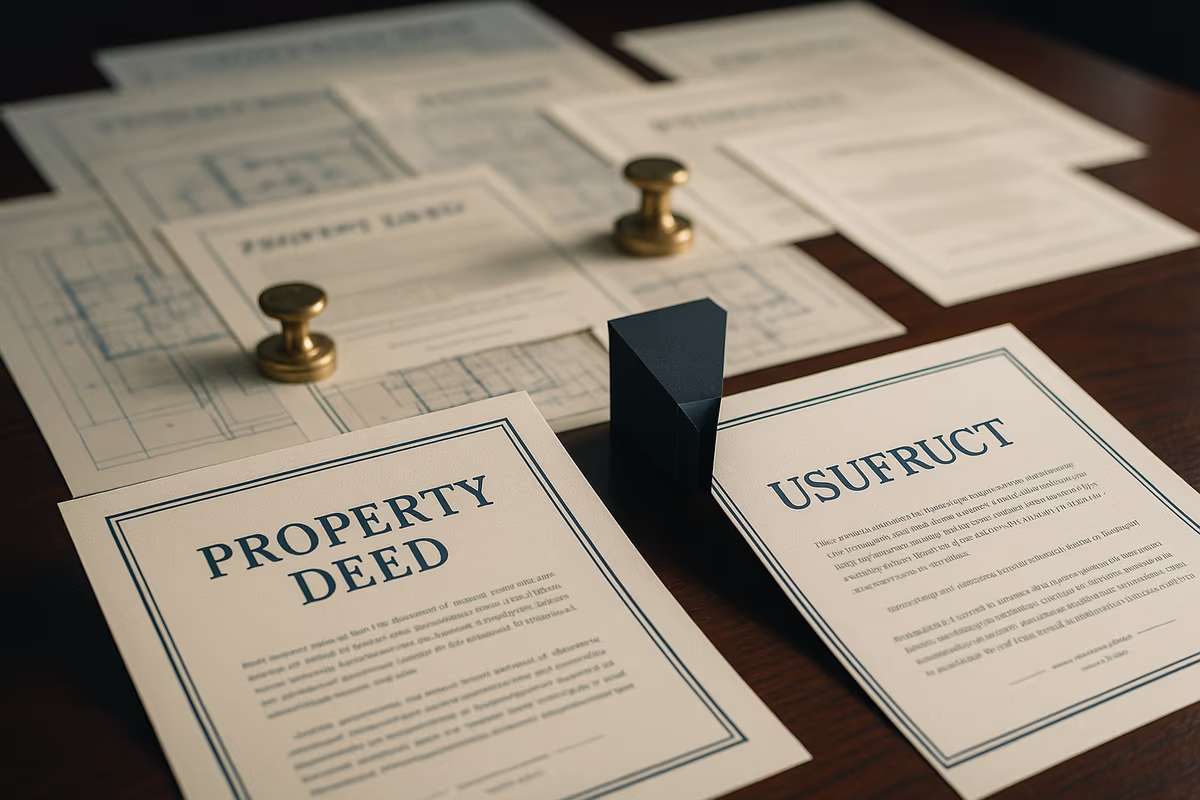

Practical guide: the drawbacks of split ownership of property
Split ownership of property (démembrement de propriété) is a complex wealth-planning technique that appeals to many owners for its tax and succession advantages. Yet this legal operation, which separates the usufruct (usufruit) from the bare ownership (nue-propriété), creates significant constraints that are often underestimated. This article analyses the main drawbacks of split ownership of property to inform your decision, whether it concerns your main residence, a portfolio of rental property or a plan for transfer within the family.
Limits on the usufructuary's right of use
Split ownership considerably restricts the powers of the usufructuary compared with a full owner. This limitation directly affects everyday use of the property.
No power to alter the substance of the property
The usufructuary cannot carry out major alterations without the agreement of the bare owner. This rule applies strictly: removing a partition wall, creating an opening, converting an attic or altering a kitchen requires the express authorisation of the bare owners. In a tense family setting, or where the bare owners are numerous, this constraint can paralyse any improvement project.
Take a 75-year-old usufructuary who wishes to adapt their home to their needs (installing a stairlift, fitting a walk-in shower). If their children, as bare owners, oppose the works for fear of a fall in value, the usufructuary is blocked in their own home.
Restrictions on the use of the property
The usufructuary must respect the property's original use. A commercial unit cannot be converted into housing, and a dwelling cannot become an office without agreement. This rigidity can be a problem given changes in the property market or personal needs.
A usufructuary holding the usufruct of a local shop in a changing neighbourhood will not be able to adapt the business to new local demand if this involves a change of use for land registry purposes, even if the change would improve profitability.
Duty of upkeep and preservation
The usufructuary alone bears maintenance repairs under Article 605 of the French Civil Code, but cannot undertake major repairs without agreement. This distinction generates recurring conflicts: where is the line between routine maintenance and major repairs? Replacing a boiler, renewing a roof and bringing the electrics up to standard are all sources of disagreement. The respective rights and obligations of the usufructuary and the bare owner are set out in question-and-answer form in our FAQ on split ownership of real property.
Financial constraints on the bare owner
The bare owner suffers substantial financial drawbacks that limit the value of their legal position for wealth-planning purposes.
No income during the usufruct
The bare owner receives no income from the property subject to split ownership. For a rental investment, this situation can last for several decades if the usufructuary is young. This absence of yield weighs particularly on wealth strategies that require regular income.
A 45-year-old daughter who receives the bare ownership of an apartment whose usufruct her 70-year-old mother retains will receive no rent for about 15 years (residual life expectancy). This tying up of capital may compromise her own property projects.
Duty to fund major repairs
The bare owner must fund the major repairs needed to preserve the property under Article 606 of the French Civil Code. This obligation can mean significant and unforeseeable costs: renewing a roof (€15,000 to €30,000), facade renovation, energy efficiency upgrades. The bare owner bears these costs without enjoying the income from the property. The scope of Article 606 of the Civil Code and the distinction between major repairs and tenant's repairs are analysed, in the context of commercial leases, in a separate article.
Difficulty obtaining bank financing
Banks are reluctant to finance the acquisition of a bare ownership. The absence of rental income and the uncertain length of the period of immobilisation make it harder to obtain a mortgage. The terms offered are often less favourable than for conventional financing. On the security that the usufructuary and the bare owner can grant, see our analysis of the mortgage over bare ownership or usufruct to secure financing.
Difficulties in day-to-day management
Split ownership significantly complicates the day-to-day management of the property because multiple agreements must be obtained.
Complexity of joint decisions
Every important decision requires the unanimous agreement of the usufructuary and the bare owners. This rule slows management considerably: choice of tenant, setting the rent, improvement works, taking out insurance. The more bare owners there are, the more laborious these decisions become.
Specific insurance issues
Insuring property subject to split ownership raises complex questions. Who takes out the policy? How are the proceeds divided in the event of a claim? The usufructuary generally has to insure the property, but the proceeds go, depending on the case, to the usufructuary (for movable items) or to the bare owners (for the building). This allocation generates frequent disputes.
A fire partly destroying an apartment subject to split ownership may set the usufructuary, who wants a quick repair in order to go on living there, against the bare owners, who prefer a more ambitious reconstruction that enhances their future wealth.
Shared rental management
Where the property is let, rental management involves both the usufructuary and the bare owners. The usufructuary collects the rent but cannot decide alone on an increase, a change of tenant or improvement works. This joint management slows decisions and may compromise rental profitability.
The risk of family conflict
Split ownership of property is fertile ground for family tension, particularly on a death.
Structural divergence of interests
The usufructuary generally favours immediate enjoyment of the property (comfort, high rental income), while the bare owners are interested in future appreciation. These divergent interests create permanent tension: the usufructuary may prefer high short-term rents where the bare owners would prefer to prioritise upkeep of the property for its long-term value.
Complications in the event of disagreement
A disagreement between the usufructuary and the bare owners can completely paralyse management of the property. Routine decisions become impossible, necessary works are postponed and the value of the property declines. This situation often requires costly and lengthy court intervention.
Compulsory transfer and psychological impact
Split ownership entails a definitive transfer of the bare ownership. The usufructuary irrevocably loses part of their assets, which may give rise to regrets later. This psychological dimension is often overlooked when split ownership is put in place.
An owner who has split their property for tax optimisation reasons may feel a loss of autonomy and control, particularly if they later wish to sell the property to fund their dependency care.
Constraints on transfer and sale
Split ownership generates significant rigidities that complicate later wealth-planning strategies.
No sale without unanimous agreement
The sale of property subject to split ownership requires the agreement of the usufructuary and all the bare owners. This rule can block a transaction that is nevertheless advantageous. A single recalcitrant bare owner is enough to prevent the sale, even if it is in the interests of all the others.
Difficulty in valuing the property
Valuing property subject to split ownership is complex because it depends on the age of the usufructuary and on the tax scales. This technicality complicates negotiations and may discourage potential buyers. The market for property subject to split ownership remains narrow and niche.
Complex and costly reunification
Reuniting the usufruct and the bare ownership (purchase of the usufruct by the bare owners or vice versa) is a complex operation requiring a precise valuation and generating transfer costs. This procedure may prove necessary to unblock a conflict but remains costly.
Lesser-known tax drawbacks
Contrary to received ideas, split ownership can have tax drawbacks depending on the situation.
Loss of certain tax advantages
The usufructuary of a rental property cannot benefit from certain tax schemes such as Pinel or Malraux depreciation, which require full ownership. This limitation reduces the tax optimisation available on rental income.
Complications for the IFI
For the real estate wealth tax (Impôt sur la Fortune Immobilière, IFI), the usufructuary and the bare owners must declare their respective rights according to their value. This allocation complicates tax returns and may lead to costly errors.
Taxation of capital gains on reunification
Reunification of the usufruct and the bare ownership may trigger capital gains taxation depending on the terms of the operation. This unexpected tax charge can make reunification less attractive financially.
A bare owner who buys the usufruct in order to resell the reconstituted property immediately may suffer double taxation: on the reunification and then on the sale, significantly reducing the point of the operation.
Solutions to limit the drawbacks
Several mechanisms can mitigate the drawbacks of split ownership of property.
Detailed agreements between the parties
An agreement between the usufructuary and the bare owners may provide for management arrangements, the allocation of costs and decision-making procedures. This contractual document limits the sources of conflict by anticipating contentious situations.
Buy-out or forced sale clause
Some agreements provide for mechanisms for buying out the usufruct or for a forced sale in the event of a major disagreement. These clauses provide an emergency exit but must be drafted precisely to avoid any dispute.
Use of a property manager
An independent professional can manage the property subject to split ownership, arbitrating between the divergent interests. This solution professionalises management but generates additional costs.
Frequently asked questions
Can the usufructuary sell their usufruct separately?
The usufructuary may transfer their usufruct to a third party, but this sale often requires the agreement of the bare owners under the agreements in place. The market for usufruct alone remains very narrow and the prices achieved are generally discounted. This operation has little economic interest in practice.
What happens if the usufructuary can no longer maintain the property?
If the usufructuary can no longer meet their maintenance obligations, the bare owners may apply to the court for forfeiture of the usufruct (déchéance de l'usufruit) or directly undertake the necessary repairs. This situation generates costly litigation and strained relations. Anticipating it by agreement remains preferable.
Is split ownership reversible?
Split ownership can be brought to an end by reuniting the usufruct and the bare ownership, but this operation requires the agreement of all the parties and generates tax and notarial costs. Reversibility is therefore never automatic or free. It is a new legal operation in its own right.
Can the bare owners force a sale of the property?
The bare owners generally cannot impose a sale without the usufructuary's agreement, save under a specific contractual clause or in exceptional circumstances (abandonment of the property by the usufructuary, inability to maintain it). This protection of the usufructuary is a fundamental principle of the law of usufruct.
How is property subject to split ownership valued for a succession?
The valuation follows the official tax scales based on the usufructuary's age on the date of valuation. The older the usufructuary, the lower the value of the usufruct and the higher the value of the bare ownership. This technical valuation requires the involvement of a professional to avoid calculation errors.
Does split ownership protect against creditors?
Split ownership offers relative protection: the usufructuary's creditors can seize only the usufruct, and those of the bare owners only the bare ownership. However, this protection is not absolute and depends on the date on which the split ownership was created relative to the date the debts arose. An asset protection strategy requires tailored legal advice.
Split ownership of property proves more complex than the tax advantages so often put forward would suggest. Before any split ownership project, a thorough analysis of the family, wealth and tax constraints is needed. Tailored legal advice makes it possible to assess whether this technique really suits your situation and to anticipate potential difficulties through appropriate drafting of the deeds.
Quatre questions suffisent à situer votre position, le délai qui vous reste et ce qu'il faut vérifier en priorité. Vous décidez ensuite si vous en parlez au cabinet.
Décrire ma situationA defect discovered after the sale?
The time limit for taking action runs not from the sale but from the discovery of the defect, and it is shorter than people think.


