
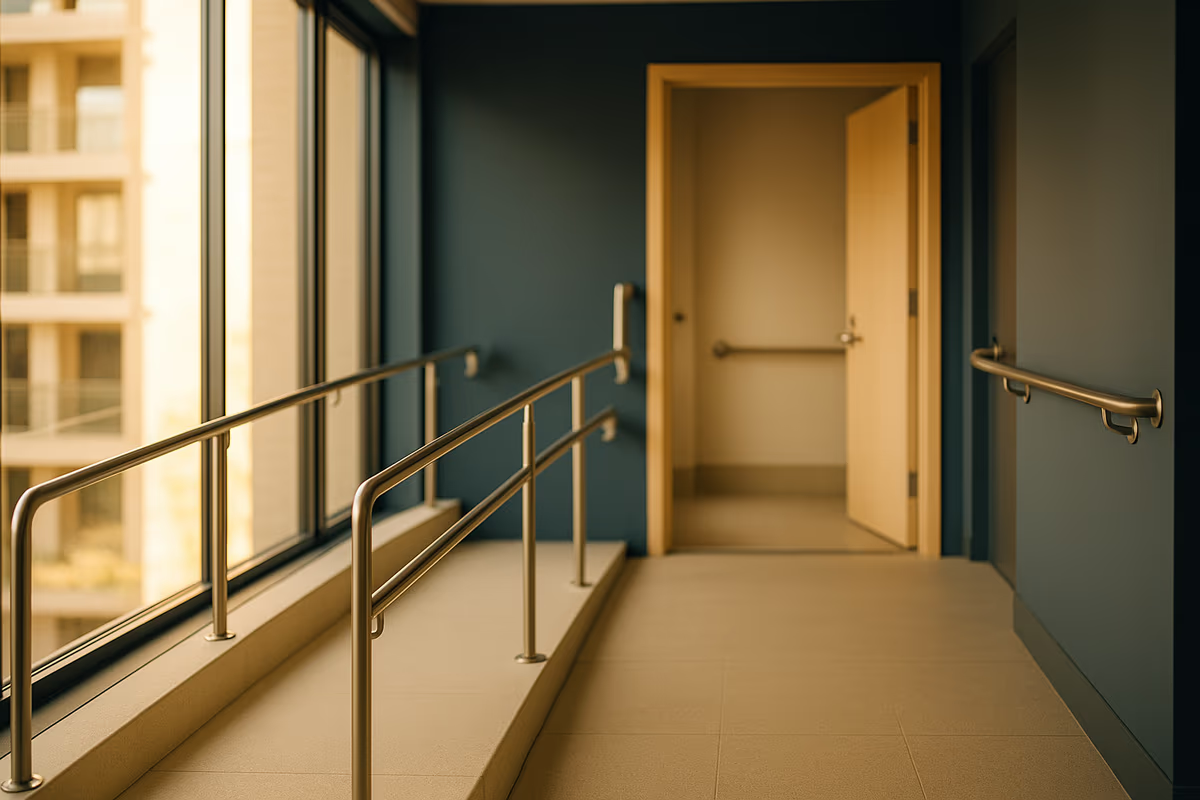

Buying a home is often a complex process for people with disabilities, who must reconcile budgetary constraints with accessibility requirements. Nevertheless, numerous public and private schemes facilitate access to home ownership, from specific financial aid to subsidised loans. This guide sets out all the mechanisms of assistance with home purchase for people with disabilities, their eligibility conditions and the practical steps for obtaining them.
The legal foundations of the right to housing for people with disabilities
The French legal framework recognises the right to housing of people with disabilities as a fundamental principle. Article L. 114-1-1 of the French Social Action and Families Code lays down the principle of universal accessibility and universal design. This approach runs through all public aid schemes.
Law No. 2005-102 of 11 February 2005 on equal rights and opportunities, participation and citizenship of people with disabilities strengthened these rights by creating the departmental centres for people with disabilities (maisons départementales des personnes handicapées, MDPH) and by making needs assessment systematic. These bodies play a central role in the award of housing aid.
Since that law, the French Construction and Housing Code has imposed strict accessibility standards for new buildings. Dwellings must comply with the technical requirements set out in the Order of 24 December 2015 on the accessibility to people with disabilities of collective residential buildings and individual houses at the time of their construction. These regulations directly influence the market for accessible housing and, indirectly, the schemes of assistance with acquisition.
Zero-rate loan (PTZ) and disability: extended conditions
The disability PTZ (prêt à taux zéro, zero-rate loan) is one of the most significant forms of assistance for home ownership by people with disabilities. Article R. 31-10-3 of the French Construction and Housing Code provides for more flexible eligibility conditions than for the standard PTZ.
Recognised disability conditions
To benefit from the disability PTZ, the applicant must establish one of the following situations:
- Recipient of the adult disability allowance (allocation aux adultes handicapés, AAH)
- Holder of a mobility inclusion card (carte mobilité inclusion) marked "invalidité" (disability) or "priorité" (priority)
- Recipient of a category 2 or 3 invalidity pension
- Recipient of an industrial accident or occupational disease annuity at a rate of at least 80%
These criteria, defined by Article D. 31-10-0-1 of the French Construction and Housing Code, give entitlement to the preferential PTZ conditions irrespective of geographical zone or increased income ceilings.
Financial advantages of the scheme
The disability PTZ makes it possible to finance up to 50% of the purchase price of an existing property with works, compared with a maximum of 40% in areas with less pressure on housing (zone détendue) for the standard PTZ. The repayment period extends to 25 years, with a deferral period of up to 15 years depending on the household's income.
Consider a recipient of the AAH wishing to acquire a home for €150,000 requiring €30,000 of accessibility works. The disability PTZ could cover up to €90,000, exactly half of the total cost of the operation.
Combination with other loans
The disability PTZ can be combined with a main loan and other assisted loans such as the social home ownership loan (prêt d'accession sociale, PAS) or the regulated loan (prêt conventionné, PC). This combination often makes it possible to finance the entire acquisition without a personal contribution, a decisive factor for households on modest incomes. The assessment of purchasing capacity and the structuring of the financing file are set out in our article on the steps involved in a first home purchase.
Assistance from the National Housing Agency (Anah)
The Anah (Agence nationale de l'habitat) runs several programmes specifically aimed at improving the housing of elderly people and people with disabilities. This assistance, governed by Article R. 321-12 of the French Construction and Housing Code, mainly concerns the adaptation of the dwelling but can be combined with a purchase project.
"Habiter facile" programme
This scheme finances works to adapt the dwelling to disability or ageing. Owner-occupiers on modest or very modest incomes may obtain a subsidy of up to 50% of the amount of the works excluding VAT, up to €10,000 (very modest incomes), or 35% up to €7,000 (modest incomes).
The link with a property purchase arises where the purchaser plans adaptation works immediately after the acquisition. The promise to sell may then make completion of the purchase conditional on obtaining these subsidies.
MaPrimeAdapt'
Launched in January 2024, MaPrimeAdapt' is gradually replacing the former schemes. This aid finances up to 70% of adaptation works for households on very modest incomes, with a ceiling raised to €22,000. The conditions of age (over 60) or disability give entitlement to this grant.
Social home ownership loan (PAS) for people with disabilities
The PAS is a main financing solution particularly suited to people with disabilities. Article R. 31-37 of the French Construction and Housing Code provides for increased income ceilings for households including a person with a disability.
Increase in income ceilings
The income ceilings for the award of the PAS are increased by €16,667 where the household includes a person with a disability. This increase, applicable irrespective of the geographical zone, significantly broadens access to the scheme.
A couple without children in zone B2 may thus qualify for the PAS up to a reference taxable income of €53,667 instead of €37,000, an increase of 45%.
Specific conditions of award
The disability PAS makes it possible to finance the acquisition of existing dwellings without any works requirement, unlike the standard PAS, which requires works of at least €4,000 in areas with less pressure on housing. This flexibility facilitates access to dwellings that are already adapted or located in serviced residences.
The interest rate of the PAS remains capped and gives entitlement to personalised housing assistance for home ownership (APL accession), creating a significant financial leverage effect for modest households.
Schemes run by local authorities
Local authorities develop local policies to assist people with disabilities with home ownership, in addition to the national schemes. These measures, based on Article L. 3211-1 of the French General Local Authorities Code, take various forms depending on the area.
Departmental loans and subsidies
Many departmental councils offer loans at preferential rates or subsidies for the acquisition of homes by people with disabilities. This assistance is generally linked to departmental social policy and disability compensation funds.
The Gironde department, for example, grants 0% loans over 20 years for the acquisition of homes by recipients of the AAH, up to €15,000 per operation.
Municipal and inter-municipal programmes
Municipalities and inter-municipal bodies sometimes develop specific schemes as part of their local housing programmes (programmes locaux de l'habitat, PLH). These measures may take the form of:
- Loan guarantees facilitating access to bank credit
- Sales of municipal land at preferential prices for the construction of accessible housing
- Subsidies for acquisition in the existing housing stock
Links with social landlords
Some local authorities develop secure social home ownership programmes specifically aimed at people with disabilities. These schemes, often run by social housing bodies (organismes HLM), offer rent-to-buy arrangements (location-accession) with appropriate support services.
Financing from social bodies
Several social bodies offer specific assistance with property financing for people with disabilities. These less well-known schemes can be a significant complement to public aid.
Action Logement (formerly 1% logement)
Action Logement offers several schemes available to people with disabilities:
- The employer loan at a preferential rate, which may be used to acquire an accessible home
- The MOBILI-PASS aid to finance the security deposit and agency fees on an acquisition
- The VISALE guarantee, which may facilitate obtaining a bridging loan
This assistance is available to employees of private non-agricultural sector companies with more than 10 employees, with no condition relating to disability but with income criteria compatible with situations of disability.
Supplementary pension funds
Supplementary pension funds (Agirc-Arrco, MSA, etc.) develop housing assistance programmes that include home ownership. This assistance may finance:
- Works to adapt the home acquired
- Part of the acquisition costs
- Support with administrative formalities
Mutual insurers and provident institutions
Some mutual insurers offer preferential loans to their members with disabilities. These schemes, which are often little known, are worth exploring as they often offer more favourable terms than standard bank credit.
Tax optimisation and disability
Property acquisition by people with disabilities gives entitlement to several tax optimisations provided for by the French General Tax Code. These schemes, which can be combined with direct aid, reduce the overall cost of the acquisition.
Tax reductions for rental investment
Article 199 sexvicies of the French General Tax Code provides for an increased tax reduction for the acquisition of new dwellings intended for letting that meet enhanced accessibility standards. This increase of €500 per square metre, up to an investment of €300,000, concerns dwellings bearing the "habitat adapté" (adapted housing) label.
Exemptions from local taxes
People with disabilities may benefit from full or partial exemptions from property tax on built property (taxe foncière sur les propriétés bâties), subject to income conditions defined by Article 1411 of the French General Tax Code. This exemption, granted by decision of the local authorities, may represent annual savings of several hundred euros.
Reduced VAT on works
Article 279-0 bis of the French General Tax Code provides for the application of the reduced VAT rate of 5.5% to works improving accessibility in dwellings completed more than two years earlier. This reduction applies to adaptation works carried out after the acquisition.
Support and legal advice
Effective access to the aid requires appropriate support to navigate the complexity of the schemes. Several bodies offer such support to people with disabilities in their home purchase project.
Role of the MDPH
The departmental centres for people with disabilities are the natural point of entry for information on housing aid. Their multidisciplinary teams assess needs and direct applicants to the appropriate schemes. They also issue the supporting documents required to open entitlements.
ADIL and energy information centres
The departmental housing information agencies (agences départementales pour l'information sur le logement, ADIL) offer free and impartial advice on home ownership assistance schemes. Their technical knowledge makes it possible to optimise the financing plan by combining the various forms of aid available.
The energy information centres (espaces info énergie) complement this support on the technical aspects of the energy upgrading of the home, which is often inseparable from adaptation to disability.
Wealth management professionals
Wealth management advisers who focus on disability develop specific knowledge of how property acquisition interacts with social and tax optimisation. Their services, which are paid for, may prove cost-effective for large acquisition projects.
Administrative steps and timetable
The success of a purchase project relying on disability aid requires rigorous planning of the administrative steps. The timetable must take into account the often lengthy processing times of the authorities.
Preparatory steps
Before any property search, it is advisable to:
- Have the disability officially recognised by the MDPH, if this has not already been done
- Put together a complete file on one's administrative situation
- Assess precisely the adaptation needs of the future home
- Run simulations of potential aid on the official websites
This preparatory phase may take three to six months depending on the complexity of the situation.
Processing of financing applications
Disability PTZ applications are generally processed within two to four weeks by the distributing banks. The PAS follows similar timescales. Anah subsidies require longer, often two to four months depending on the department.
It is recommended to submit all aid applications at the same time as soon as the preliminary sale agreement (compromis de vente) is signed, making the notarial deed of sale conditional on obtaining them. On the financing and negotiation mistakes to avoid up to signature, see our analysis of the pitfalls of buying property.
Follow-up and appeals
If an application for aid is refused, administrative appeals must be lodged promptly. An informal appeal (recours gracieux) to the processing body is often an effective first step, accompanied where necessary by a legal challenge before the competent administrative court.
Frequently asked questions
Is the AAH sufficient to obtain a mortgage?
The AAH is a stable income recognised by banks, but its amount often limits borrowing capacity. Combining it with the disability PTZ, family assistance and a personal contribution generally makes it possible to build a viable financing plan. Banks apply the standard 35% debt-to-income ratio to the AAH. The involvement of an intermediary in negotiating the loan and the terms of their remuneration are dealt with separately in our article on the role of the mortgage broker.
Can the disability PTZ be combined with Anah subsidies for works?
Yes, these schemes can be fully combined. The disability PTZ finances the acquisition and part of the works, while Anah subsidies complete the financing of the adaptations. This combination often makes it possible to cover all adaptation costs.
Do the heirs of a person with a disability benefit from the same aid?
No, disability home purchase aid is strictly personal and linked to the applicant's disability. Heirs cannot take over these schemes, even if they inherit an adapted home acquired with this aid.
What is the difference between a disability card and MDPH recognition for the purposes of aid?
The mobility inclusion card marked "invalidité" (disability) is sufficient for the disability PTZ and most national aid. MDPH recognition complements this by assessing specific needs and directing applicants to local aid and disability compensation benefits.
Are accessibility works tax-deductible?
Accessibility works give entitlement to the energy transition tax credit if they also concern energy improvement. They systematically benefit from the reduced VAT rate of 5.5% and may, subject to conditions, be financed by non-taxable public subsidies.
Is it better to buy new or existing property to benefit from disability aid?
The choice depends on adaptation needs and the availability of accessible housing. New property offers guaranteed regulatory accessibility but costs more. Existing property with works often allows tailor-made adaptation financed by dedicated aid, at a lower overall cost.
How can notary's fees be financed on a purchase with disability aid?
Notary's fees are not covered by public aid but may be financed by the main loan or by additional loans. Some banks offer works loans including ancillary costs for people with disabilities. The MOBILI-PASS aid may also contribute to these costs.
Access to home ownership for people with disabilities requires a comprehensive approach combining public schemes, local aid and tax optimisation. The key lies in anticipating the steps and obtaining support from professionals familiar with the specific needs of these groups. Before any project, consult your MDPH to review your entitlements and build your financing plan with the help of a professional who acts in this area.
Quatre questions suffisent à situer votre position, le délai qui vous reste et ce qu'il faut vérifier en priorité. Vous décidez ensuite si vous en parlez au cabinet.
Décrire ma situationA defect discovered after the sale?
The time limit for taking action runs not from the sale but from the discovery of the defect, and it is shorter than people think.


