
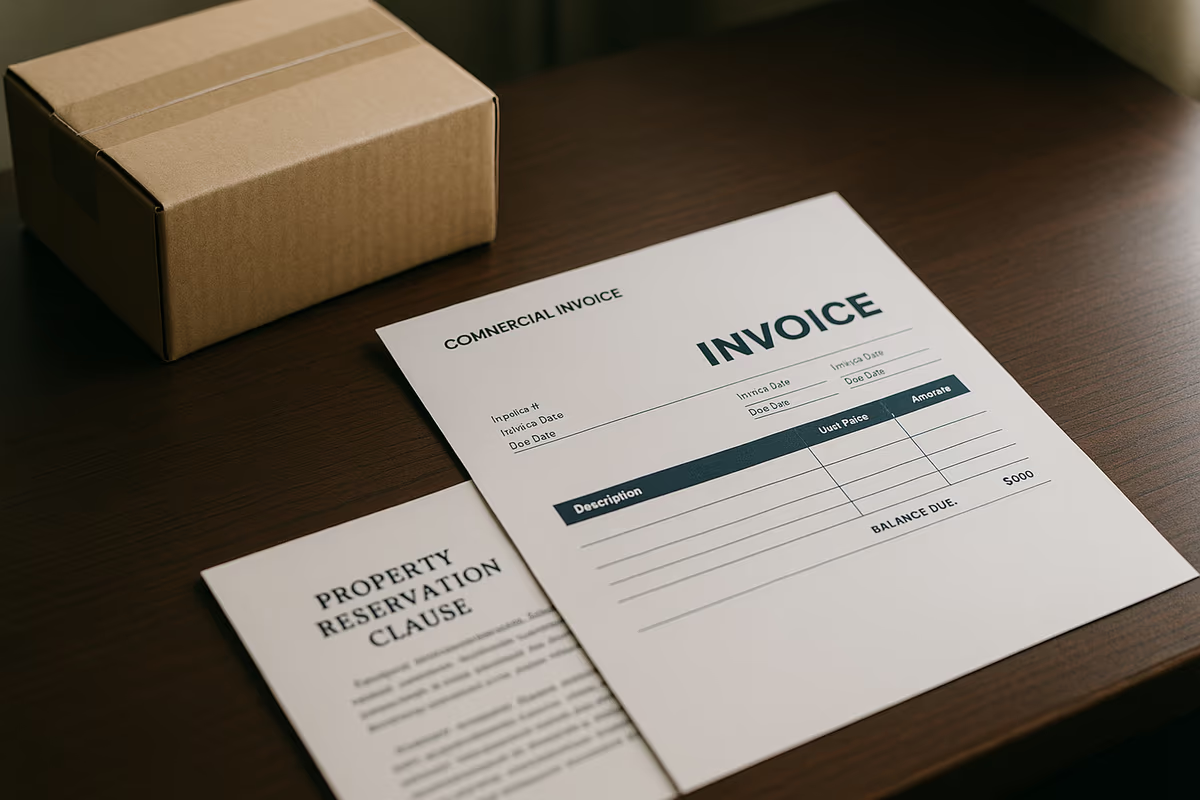

A supplier delivers goods to a customer, grants a payment period, and then learns a few weeks later that the customer has been placed in court-supervised reorganisation (redressement judiciaire). The invoices remain unpaid, but the products are still in the debtor's warehouse. Must the supplier resign itself to filing a claim that may never be paid, or is there a way to physically recover the goods delivered? A retention of title clause (clause de réserve de propriété), where it has been properly stipulated, opens up this second route. This guide explains how to reclaim unpaid goods in collective insolvency proceedings (procédure collective), what conditions must be met, and above all how to comply with the strict three-month deadline on which everything depends.
What a retention of title clause is and why it protects the unpaid seller
A retention of title clause is a mechanism that is simple in principle and highly effective in its effects. The seller delivers the goods but remains the legal owner for as long as the buyer has not paid for them in full. The transfer of ownership, which ordinarily takes place as soon as the parties agree on the thing and the price, is suspended until full payment.
Article 2367 of the French Civil Code sets out this definition:
Ownership of a thing may be retained as security by means of a retention of title clause which suspends the transfer effect of a contract until full payment of the obligation constituting its counterpart. Ownership thus reserved is an accessory of the claim whose payment it secures.
This text contains two essential ideas. First, ownership is a security tool: the seller retains a real right over the thing, and not merely a personal claim. Second, this ownership is an accessory of the claim. In other words, it follows the fate of the debt and disappears as soon as the price is paid.
The value of this mechanism becomes fully apparent when the customer becomes insolvent. A supplier that has made no provision for retention of title is merely an unsecured creditor (créancier chirographaire) among others: it files its claim and waits for a distribution which, in most reorganisations and liquidations, is limited to a derisory fraction of the amount owed. A supplier that has stipulated a valid retention of title clause has, by contrast, a right of ownership that it can assert in order to recover the goods themselves.
The conditions of validity of the clause
A retention of title clause has effect only if it has been properly agreed. Article 2368 of the French Civil Code requires a written document: retention of title is agreed in writing. That document may appear in the sale contract, in the general terms of sale, on the purchase order or on the invoice, provided that it has been accepted by the buyer.
The critical point in collective insolvency proceedings concerns the timing of that agreement. The writing stipulating the retention of title must have been agreed between the parties no later than the time of delivery. A clause that appeared only on an invoice issued after delivery, without ever having been brought to the buyer's attention beforehand, is liable to be set aside. In practice, a well-advised seller inserts the clause in its general terms of sale, has them accepted from the time of the order, and repeats it on every delivery note and every invoice.
An example helps to illustrate the point. Take a building materials wholesaler that regularly supplies a craftsman. Its general terms of sale, accepted when the account was opened, contain a clear retention of title clause. Each delivery note refers to it. When the craftsman is placed in reorganisation, the wholesaler has a solid basis on which to reclaim the unpaid materials still on the site or in stock. Conversely, a supplier that had mentioned the clause only on its invoices, without ever having had it accepted, would be in a much weaker position.
The opening of collective insolvency proceedings: what changes for the seller
As soon as a judgment opens safeguard proceedings (sauvegarde), court-supervised reorganisation (redressement judiciaire) or compulsory liquidation (liquidation judiciaire), several mandatory rules apply to the supplier. The first is the prohibition of individual enforcement actions and the stay of payment of pre-existing debts. The seller can no longer claim its money directly from the customer: it must file its claim with the creditors' representative (mandataire judiciaire) within the statutory time limits, in principle two months from the publication of the opening judgment in the BODACC (French official gazette of civil and commercial announcements).
However, filing a claim and reclaiming goods are two distinct steps that must never be confused. Filing a claim aims to have the amount owed recognised and to take part in any distributions. Reclaiming goods aims to recover the assets of which the supplier has remained the owner thanks to the retention of title clause. A prudent supplier takes both steps: it files its claim to preserve its rights should the reclaim fail, and it reclaims its goods in an attempt to recover them in kind. The time limits to be observed and the errors that deprive the creditor of its rights are set out in our article on filing a claim in collective insolvency proceedings.
Reclaiming goods in collective insolvency proceedings rests on the idea that those goods do not belong to the debtor: they therefore do not form part of the creditors' common pledge. The owner comes to take them back, as it would take back an asset that had been lent or let. Strict conditions and a tight timetable must nevertheless be respected.
The three-month deadline: the most common trap
This is the rule that decides, in the vast majority of cases, whether the step succeeds or fails. Article L. 624-9 of the French Commercial Code imposes a mandatory time limit:
A claim for the recovery of movable property may be brought only within three months following the publication of the judgment opening the proceedings.
This three-month period runs from the publication of the opening judgment in the BODACC, and not from the day on which the supplier learns of the proceedings through another channel. This is a crucial point and a frequent source of error: a seller who discovers the situation late, for example following a reminder that went unanswered, may already have used up a substantial part of the period without knowing it.
This three-month period is a time bar (forclusion). Once it has expired, the reclaim action is inadmissible, with no possibility of remedy. The supplier then becomes once again a mere unsecured creditor, reduced to hoping for a distribution out of the assets. A retention of title clause, however perfectly drafted, is of no further use if the reclaim has not been brought in time. The calculation of this period and time-bar situations are dealt with separately in our article on the time limit for reclaiming goods in collective insolvency proceedings.
In practice, several steps should be taken as soon as a customer is reported to be in difficulty:
- monitor BODACC publications concerning at-risk customers, so as not to depend on information supplied by the debtor itself
- identify immediately, as soon as the judgment is known, all unpaid deliveries that may be reclaimed
- calculate without delay the date on which the three-month period expires and set an internal deadline well in advance
A supplier that handles several dozen customer accounts benefits from putting systematic monitoring in place. A reclaim in court-supervised reorganisation fails more often through neglect of the calendar than through lack of legal basis. On how to organise this monitoring and the signals to follow, see our analysis of monitoring a debtor's financial health.
The substantive conditions of the reclaim
Complying with the deadline is not enough. The goods reclaimed must also meet the conditions laid down by Article L. 624-16 of the French Commercial Code. Two requirements dominate: the goods must exist in kind and be identifiable.
The goods must be found in kind
A reclaim presupposes that the goods are found in kind, that is to say physically present, on the day the proceedings are opened. The supplier can reclaim only what still exists. If the goods have been consumed, irreversibly incorporated into another product or resold to a third party, reclaiming them in kind is no longer possible, even if everything else is in order.
Returning to the example of the building materials wholesaler: if it delivered bags of cement still stored in the craftsman's warehouse, those bags exist in kind and can be reclaimed. If, however, the cement has already been poured into a slab, it no longer exists as an identifiable and distinct asset: reclaiming it in kind is closed off. The supplier will have to fall back, where appropriate, on other mechanisms discussed below.
Identification of the goods and the case of fungible goods
The goods reclaimed must be capable of being identified as those actually delivered by the supplier. This requirement poses a particular difficulty for fungible goods, that is, interchangeable goods counted by weight, volume or quantity, such as raw materials, bulk chemicals or standardised components.
Article L. 624-16 of the French Commercial Code provides a pragmatic answer: a reclaim may be made in respect of fungible goods where goods of the same nature and quality are found in the debtor's stock. The supplier therefore does not have to prove that a particular bag is the one it delivered; it is sufficient to show that equivalent goods, in sufficient quantity, are in stock. This solution considerably facilitates the reclaiming of goods in collective insolvency proceedings where several suppliers deliver identical products.
The reclaim procedure step by step
The reclaim is subject to precise formalities. The first step is the reclaim request sent by the supplier. This request must be sent to the court-appointed administrator (administrateur judiciaire) where one has been appointed, or otherwise to the debtor, by registered letter with acknowledgement of receipt. The date of dispatch or receipt must fall within the three-month period.
The request describes the goods reclaimed precisely, refers to the retention of title clause and attaches the supporting documents: accepted general terms of sale, purchase orders, delivery notes and unpaid invoices. The better documented the file, the greater the chance that the step will succeed without litigation.
After receipt, two scenarios arise. In the first, the administrator or the debtor agrees to the request, with the consent of the creditors' representative: the supplier then recovers its goods without having to apply to a judge. In the second scenario, the request is refused or receives no answer. The supplier must then refer the dispute to the supervisory judge (juge-commissaire) for determination. That referral must be made within one month from the expiry of the period allowed to the administrator or the debtor to reply. Here again, vigilance as to time limits is decisive: a supplier that succeeded on the merits but referred the matter to the supervisory judge out of time would see its request rejected.
Exemption from reclaiming where the contract has been published
The French Commercial Code provides a facility for published sale contracts. Where the contract relating to an asset subject to retention of title has been the subject of publicity, the owner may be exempted from making a reclaim request within the three-month period and may simply make a request for restitution. This mechanism nevertheless remains marginal in ordinary sales of goods, where retention of title most often arises from unpublished general terms. For the overwhelming majority of suppliers, the step to remember remains the reclaim within the three-month period.
When the goods have disappeared: the transfer to the price
What happens where the customer has already resold the goods delivered before the proceedings were opened, or where an insurer has compensated for them following a loss? The supplier is not necessarily left without recourse. Article L. 624-18 of the French Commercial Code provides for a transfer of the right of ownership to the claim for the price or to the indemnity.
In concrete terms, if the customer has resold the goods but the sub-purchaser has not yet paid, the supplier may claim the resale price not yet paid, up to the amount of its own claim. This is the mechanism of real subrogation (subrogation réelle): the retained ownership, which can no longer be exercised over the thing that has disappeared, transfers to what replaces it, that is, the price. This transfer presupposes that the price is still identifiable and unpaid on the day of the opening judgment. If the sub-purchaser has already paid the debtor, the transfer becomes impossible and the sum merges into the debtor's assets.
This mechanism illustrates the usefulness of drafting an extended retention of title clause, expressly providing for its transfer to the resale price and to insurance indemnities. A well-designed clause anticipates these situations and protects the supplier beyond the mere physical recovery of the goods.
Errors to avoid and good practice
Experience of commercial litigation shows several recurring pitfalls which cause reclaims that were perfectly well founded at the outset to fail.
The first pitfall is the absence of a written document or late stipulation of the clause. A retention of title that appears only on the invoice, without prior acceptance by the buyer, is open to challenge. The clause must be agreed in writing and accepted no later than at delivery.
The second pitfall, the most frequent, is missing the three-month deadline. Many suppliers discover the proceedings too late or are slow to assemble their file. Putting in place BODACC monitoring and rigorous follow-up of at-risk customer accounts is the best safeguard.
The third pitfall lies in confusing the filing of a claim with a reclaim. Filing a claim is not a reclaim and does not interrupt the three-month period. The two steps must be pursued in parallel and independently.
The fourth pitfall concerns proof that the goods exist in kind and are identifiable. A supplier that cannot show that its goods are physically in the debtor's stock, or that has not kept traceability records, risks a refusal. Batch numbers, detailed delivery notes and precise references are all elements that facilitate identification.
Conclusion: speed takes precedence over everything
The retention of title clause is one of the few security interests that effectively withstands the customer's collective insolvency proceedings, because it rests on a right of ownership and not on a mere ranking as a creditor. But its effectiveness depends on flawless execution, both upstream and downstream. Upstream, the clause must be stipulated in writing, accepted before delivery, repeated on every commercial document and, ideally, extended to a transfer to the resale price. Downstream, the reclaim must be brought within the three-month time bar following publication in the BODACC, in respect of goods that exist in kind and are identifiable.
The central message of this guide can be put in one sentence: where a customer is in court-supervised reorganisation, time works against the supplier. A perfectly well-founded right is irretrievably lost if the reclaim request arrives one day too late. As soon as a debtor customer is reported to be in difficulty, calculate the date on which the three-month period expires, gather your delivery notes and unpaid invoices without delay, and have your reclaim request secured by a professional before sending it to the court-appointed administrator.
Frequently asked questions
What is the time limit for reclaiming goods in court-supervised reorganisation?
The reclaim must be brought within three months following the publication of the opening judgment in the BODACC, pursuant to Article L. 624-9 of the French Commercial Code. This period is a time bar: once it has expired, the action is inadmissible and cannot be remedied. The starting point is the official publication, and not the date on which the supplier learns of the proceedings by other means. It is therefore prudent to monitor BODACC publications concerning at-risk customers.
Does filing a claim amount to reclaiming the goods?
No, these are two distinct and independent steps. Filing a claim, to be made in principle within two months of publication of the judgment, allows the creditor to take part in distributions. The reclaim, to be brought within three months, aims to recover the assets of which the supplier has remained the owner thanks to the retention of title clause. A well-advised supplier pursues both in parallel, the claim serving as a safety net if the reclaim fails.
Must the retention of title clause be in writing?
Yes. Article 2368 of the French Civil Code requires that retention of title be agreed in writing. That document may be found in the contract, the general terms of sale, the purchase order or the invoice, but it must have been accepted by the buyer no later than at the time of delivery. A clause appearing only on an invoice issued after delivery, without prior acceptance, is liable to be set aside in the event of a dispute.
Can goods already resold by the customer be reclaimed?
Reclaiming in kind is no longer possible if the goods have left the debtor's estate, but Article L. 624-18 of the French Commercial Code allows the right of ownership to transfer to the resale price not yet paid. The supplier may then claim the price from the sub-purchaser, up to the amount of its own claim, provided that the price is still identifiable and unpaid on the day of the opening judgment. If the sub-purchaser has already paid the debtor, this transfer becomes impossible.
How can fungible goods such as raw materials be reclaimed?
Article L. 624-16 of the French Commercial Code allows fungible goods to be reclaimed where goods of the same nature and quality are found in the debtor's stock in sufficient quantity. The supplier does not have to prove that a particular batch is the one it delivered. Good traceability, with batch numbers and detailed delivery notes, nevertheless makes the showing easier and limits disputes.
What should be done if the court-appointed administrator refuses the reclaim?
Where the request sent by registered letter with acknowledgement of receipt is refused or receives no answer, the supplier must refer the dispute to the supervisory judge for determination. That referral must be made within one month from the expiry of the period allowed to the administrator or the debtor to reply. A well-documented file, with accepted general terms, delivery notes and invoices, significantly increases the chances of success before the supervisory judge.
Does retention of title withstand the customer's compulsory liquidation?
Yes, the mechanism applies in safeguard proceedings and reorganisation as it does in compulsory liquidation. In every case, the assets that remain the supplier's property do not form part of the creditors' common pledge and may be reclaimed on the same conditions, in particular the three-month period and the existence of the goods in kind. Liquidation therefore does not deprive the supplier of its right of ownership, provided that it acts within the time limits and in respect of identifiable goods.
Quatre questions suffisent à situer votre position, le délai qui vous reste et ce qu'il faut vérifier en priorité. Vous décidez ensuite si vous en parlez au cabinet.
Décrire ma situationA business whose cash flow is tightening?
Once forty-five days have passed since the cessation of payments, options narrow and the director's liability is exposed.


